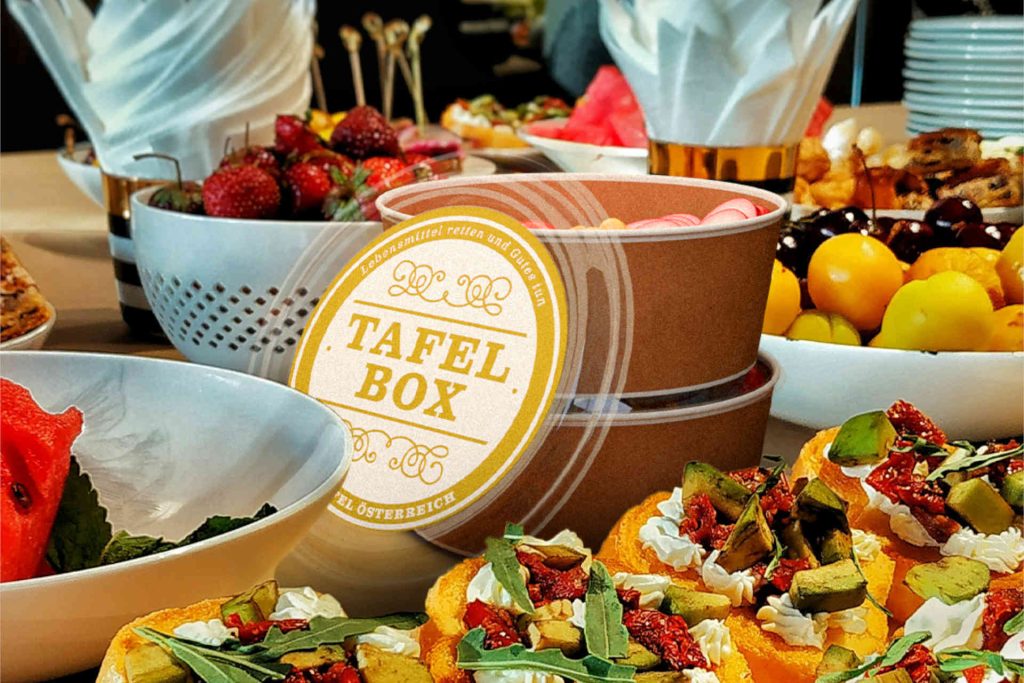
“The TafelBox is a visible sign of responsibility in action. It connects hosts, guests, and those in need in a holistic system.”
Alexandra Gruber, Managing Director, Die Tafel Österreich
Takeaway without a guilty conscience – and with social added value: since its relaunch in 2024, the TafelBox has become one of the most effective tools against food waste in Austria. The simple principle: guests take leftover food home with them – and at the same time donate to a good cause. For every box sold, 20 cents go directly to Die Tafel Österreich to provide people affected by poverty with rescued food.
Within a year, 15,000 boxes have already been used—in restaurants, hotels, catering services, and events. This corresponds not only to 7,500 kg of food saved and 22,500 kg of CO2 emissions avoided, but also to €3,000 in donations, which have enabled 15,000 additional meals for people in need. An example of the circular economy in action – both ecologically and socially.
From the perspective of partner companies such as the KASTNER Group and Pacovis, it is also clear that the TafelBox is more than just packaging – it is a symbol of respectful use of resources, social fairness, and real impact in the catering industry.
“The TafelBox is a best-practice example of how ecological, social, and economic sustainability can go hand in hand.”
Albin Lintner, Pacovis
Artificial intelligence has become part of everyday life in many businesses – but by 2026, it will become a structural imperative. The focus is no longer on testing individual tools, but on the question of how AI can be deployed reliably, effectively, and across the entire organization. Examples from tourism, events, and organizations already demonstrate today how scaling works in practice – and where AI specifically reduces the workload.
A clear turning point is emerging for the year 2026. The company-wide deployment of AI is taking center stage. This is the conclusion reached by Hamburg-based AI expert and interim manager Eckhart Hilgenstock, who has analyzed numerous national and international studies on the development of artificial intelligence. His conclusion is clear: “Following the pilot project phase in 2024/25, many companies are aiming to scale AI within their organizations by 2026.”
Dry January is no longer just a month of abstinence. It’s a barometer. For changing guest preferences. For more conscious consumption patterns. For a new aesthetic of enjoyment. Anyone who still believes in 2026 that non-alcoholic drinks are merely lemonade in a crystal glass has failed to grasp the trend. At Bar Montez in the Rosewood Munich, Bar Manager Mario Sel demonstrates just how sophisticated, structured, and gastronomically relevant non-alcoholic creations can be today – and why they have long been a strategic component of contemporary bar culture.
Across all areas of life, the food service industry is becoming more emotional, flexible, and relevant: Chain restaurants are showing more character, transit dining is evolving from a quick stop to an experiential space, and in the context of New Work, cuisine is becoming a central factor for culture, health, and employer attractiveness.
Takeaway without a guilty conscience – and with social added value: since its relaunch in 2024, the TafelBox has become one of the most effective tools against food waste in Austria. The simple principle: guests take leftover food home with them – and at the same time donate to a good cause. For every box sold, 20 cents go directly to Die Tafel Österreich to provide people affected by poverty with rescued food.