
The pilot phase is over – now it’s time for implementation
The studies analyzed by Hilgenstock all show that more and more companies are actively integrating AI into their processes. The focus is shifting away from individual test applications toward organization-wide adoption. The goal is to extend the efficiency gains from pilot projects to other areas. AI applications are increasingly being deployed across departmental boundaries – from sales and back office to operational processes, finance, and human resources.
Hilgenstock interprets this development as follows: “The first-mover advantage enjoyed by the pioneers from 2023 to 2025 is now paying off through a scaling advantage for those who can quickly adapt their experiences and integrate them into their organization.”
Productivity, Quality, Speed: Why AI Pays Off Now
A key finding of the studies is the measurable economic benefit of AI. The Accenture report shows that generative AI automates manual, administrative tasks and enables productivity gains of up to 40 percent – for example, in reporting, data analysis, or content creation. IBM confirms significant cost savings through strategically implemented AI, such as via optimized operational processes or automated document processing. BCG emphasizes that AI not only boosts efficiency but also improves the quality of decisions because executives can access reliable data more quickly. For Hilgenstock, the key point is: “Strategy must not be an excuse for a vision without profitability.”
According to the United Interim Economic Report 2025, many companies are currently focused on identifying concrete and economically viable use cases for AI. Implementation often begins in clearly defined areas such as business development or back-office operations and is subsequently expanded. Hilgenstock describes this approach as sensible – with one clear caveat: “Beyond the pilot phase, it is essential to consider scaling from the very start of every single project.”
The fear of being replaced!
Studies also show that the success of AI projects does not depend solely on technology. Corporate culture and leadership play a central role. KPMG analyses emphasize that employee trust is crucial. If there is a fear of being replaced by AI, implementation projects often encounter resistance. Hilgenstock describes this dynamic from a practical perspective: “If employees are afraid that AI will replace them, they will more or less openly boycott any AI implementation.”
That is why it is crucial to demonstrate early on how AI provides concrete support. An example: “When the sales team sees how AI tools can be used to generate leads and win new contracts, they’re immediately on board.” Roles are also changing at the executive level. Studies such as “Careers with AI” show that AI is perceived not only as a risk but also as a professional opportunity, especially for those who establish themselves as competent points of contact within the company.
When expertise is lacking – and resources are scarce
This trend is particularly evident in tourism, hospitality, and destination-based organizations. The industry is characterized by complex processes, seasonal peaks, numerous interfaces, and significant coordination efforts – ranging from visitor flows and infrastructure to financing, mobility, and public spaces. At the same time, many businesses lack the resources to test new technologies risk-free or integrate them strategically.
To ensure that AI does not remain confined to isolated flagship projects, structured approaches, secure test environments, and practical support are needed. This is precisely where it becomes clear why, in addition to internal company initiatives, public innovation infrastructures play a central role – especially for small and medium-sized enterprises in tourism.
While many companies have recognized the benefits of AI, they often lack the resources, expertise, or secure testing environments. This is precisely where European Digital Innovation Hubs (EDIHs) come in.
European Digital Innovation Hubs (EDIHs)
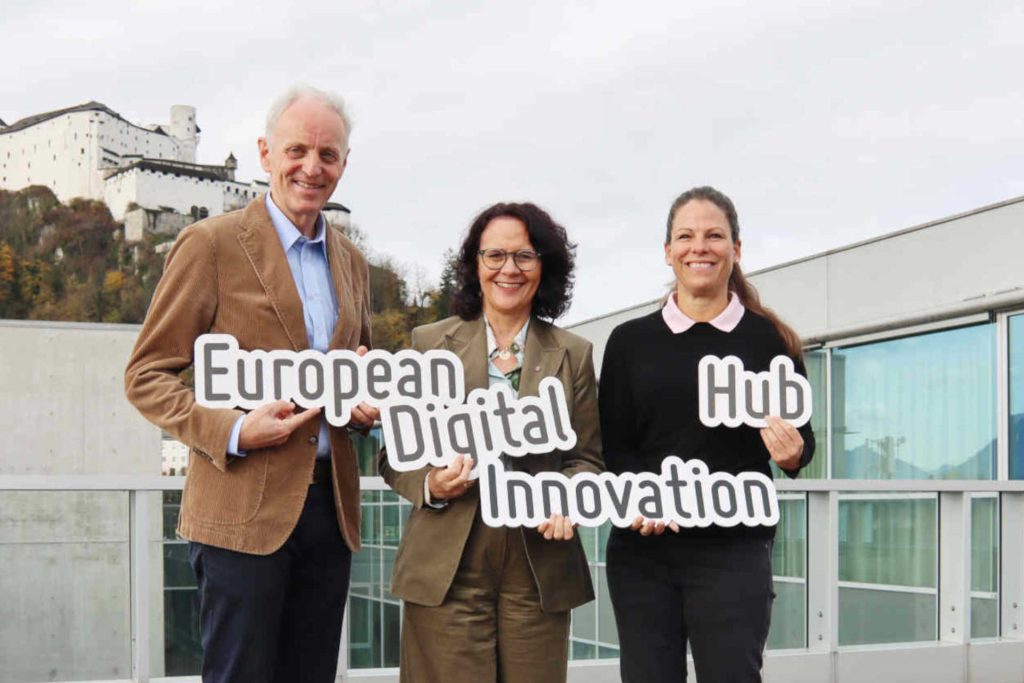
The EDIH Crowd in Motion – AI supports businesses and public institutions in the fields of tourism, mobility, sports, and well-being in their digital transformation. Following a successful first funding period, the hub will continue its work starting in 2026 with an expanded scope. Provincial Councilor Daniela Gutschi emphasizes its importance for tourism: The hub provides easy access to AI, cutting-edge technology, and European expertise, creating additional momentum for value creation, skills development, and international networking. Coordinator Olivia Zechner highlights the expanded focus: Starting in 2026, more than half of the services will be specifically dedicated to artificial intelligence – including an AI helpdesk, connections to European AI infrastructures, and enhanced funding opportunities.
Specific Applications
Even during the first funding period, Crowd in Motion demonstrated how AI can be put to practical use:
- a feasibility study for an AI-powered visitor guidance system at the DomQuartier in Salzburg
- crowdfunding for a new gondola lift in Fieberbrunn
- AI applications in the public sector, including a project with the city of Villach
- Sensor-based AI projects in the sports and fitness sector
These examples illustrate how digital innovation and AI address specific challenges in tourism and destination-related structures.
Reclaim Seven Hours a Week: How AI Is Transforming Event Planning
In addition to strategy and infrastructure, another aspect is coming into focus: the significant time spent on organizational tasks. According to a study commissioned by Perk, employees lose an average of about seven hours a week to so-called “shadow work” – administrative tasks outside their core competencies. This is where Perk’s new event solution comes in. With Perk Events, the company automates the entire planning of team events – from venue search and group bookings to travel coordination for up to 5,000 people. President & COO Jean-Christophe Taunay-Bucalo describes the problem as follows: “Events are one of the biggest sources of indirect work—they rob teams of valuable time.”
For Austria, Managing Director Stephan Hebenstreit points to the particular pressure to improve efficiency due to a shortage of skilled workers, rising costs, and regulatory requirements. Automation creates clear processes and noticeably reduces the workload on employees. Users also report practical benefits: “Perk Events makes my life much easier. Everything can be found on the platform”, says Daniela Merizaldem of Storyblok.
Our conclusion for the future: AI as a structuring factor of the future
The three perspectives – study analysis, innovation infrastructure, and concrete application – paint a consistent picture: AI is evolving from an experiment into a structural tool. For tourism, hospitality, and related sectors, this means one thing above all else: The success of AI depends not on individual tools, but on the ability to integrate technology, organization, and culture. 2026 will thus be the year when we move from testing to shaping the future.


From Genusspunkt 1/2026